 (929) 244-2015

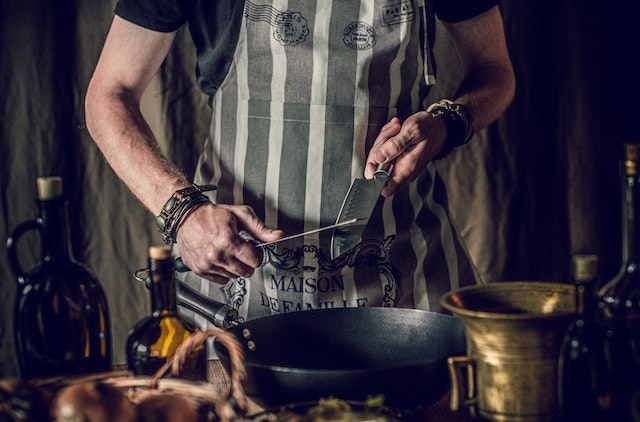
There may be some differences of opinion about the best must-have tools for cooking, but most home chefs can agree that high-quality knives are essential. But even if you’ve got the best knife on the market, it’s useless without a sharp edge. So what is the best way to sharpen knives at home? Lots of families use either a manual or an electric knife sharpener. Both function similarly but differ primarily in how they interface with the user. Regardless of how you get the job done, Food & Wine Magazine advises that the best way to sharpen kitchen knives is to use a method you understand and are comfortable with. Think about the amount of time you want to spend sharpening your knives and then decide which approach works best for you.
What You’ll Need
Manual Sharpener
We love the Chef’sChoice Pronto #463 Pronto Diamond Hone Manual Knife Sharpener. It applies a flawless and durable 15-degree edge in seconds and will put a better-than-factory edge on your 15° class knives! This sharpener uses 100% diamond abrasives in Stages 1 and 2 and features a “Soft Touch” handle for an easy and secure grip.

>> Shop the Chef’sChoice Pronto #463 Pronto Diamond Hone Manual Knife Sharpener <<
Electric Sharpener
If you prefer an electric sharpener, take a look at the Chef'sChoice 115207 Angle Select Diamond Hone Knife Sharpener. It’s one of the most versatile sharpeners in the world, designed to apply incredibly sharp edges to all your European/American and Asian style knives (15° and 20° class knives). It even features a three-stage AngleSelect system that allows you to choose exactly which type of knife you’re sharpening: kitchen, sports, pocket, or serrated.
>> Shop the Chef'sChoice 115207 Angle Select Diamond Hone Knife Sharpener <<
The Best Way to Sharpen Kitchen Knives at Home
Using a manual sharpener:
- Place your knife into the “coarse” slot of the sharpener. Gently draw your knife through the slot using steady, even pressure.
- Repeat this step about three to six times.
- Next, place your knife into the “fine” slot of the sharpener. Gently draw your knife through the slot once or twice using steady, even pressure.
Using an electric sharpener:
- Take time to carefully read the knife sharpener's instruction manual carefully before using it.
- Place your knife into the “coarse” slot and gently pull it through using a smooth, controlled motion. The machine does most of the work for you.
- Swap sides. Repeat the same motion on the other side of the knife.
- Continue to repeat this series of steps three to six times.
- Then, switch to the “fine” slot and repeat steps two through four.
How Often You Should Sharpen Knives at Home
In general, it’s a good idea to sharpen your knives whenever they start to feel dull. That can vary depending on the quality of your knives and how frequently you use them. For the average home chef, this may be about two to three times a year. One way to test your knives is to try to cut a tomato cleanly. If you can’t do it, you probably need to sharpen. Another way to test your knife’s sharpness is to hold a sheet of copy paper up in one hand and try to vertically slice it with the knife. If it doesn’t work, use the sharpener.
Using a Honing Steel
Once you’ve completed these steps, you’ll want to keep your knife sharp for as long as possible. Using a honing steel is a great way to do that. This is a long, thin metal tool that looks kind of like a sword and helps align all the metallic ions in your blade’s edge for smoother, more accurate cutting. To use it, hold the honing steel vertically against your kitchen counter in your non-dominant hand. Place the knife nearly flat against the steel at about 22° (picture it as half of a 45° angle), then pull it across the honing steel about ten times on each side. The steel won’t re-sharpen a dull blade, but it can help you maintain an edge longer on a well-sharpened knife.